
iGaming Ontario (iGO) is the provincial Crown agency that conducts and manages online gambling offered through private operators in Ontario, while the Alcohol and Gaming Commission of Ontario (AGCO) registers those operators and sets the rules they follow. For you as a player, the practical point is simple: a site that sits inside this system must meet Ontario’s standards on age, location, limits and complaints, and a site outside it does not. This guide explains how the pieces fit, how to confirm a site belongs to the regulated market, and which protections and terms to look at before you deposit.
TL;DR
- iGaming Ontario is a Crown agency that conducts and manages online gaming through regulated private operators. The AGCO registers operators and sets the standards. OLG.ca is run separately by OLG.
- You must be 19 or older and physically in Ontario to wager. Check for the iGaming Ontario and BetGuard logos, then confirm the site in iGO’s regulated-site directory.
- Every regulated site must offer spend and time limits, short-term breaks and self-exclusion, and BetGuard lets you opt out across regulated Ontario sites.
- If a dispute with an operator is not resolved, you can take it to iGO for review. The AGCO handles breaches of the rules, not individual money disputes.
- Read the wagering multiple on any bonus before you accept it.
Table of Contents
- What iGaming Ontario actually is
- Who does what: iGO, the AGCO and OLG
- How to tell whether a site is regulated
- Why you have to be in Ontario, and what that means on your phone
- The protections every regulated site must offer
- If something goes wrong: complaints in the regulated market
- Reading bonus and reward terms
- What changed recently
- Choosing a site inside the regulated market
- Comparing Ontario casinos with TechPicks
- FAQ
- Sources
What iGaming Ontario actually is
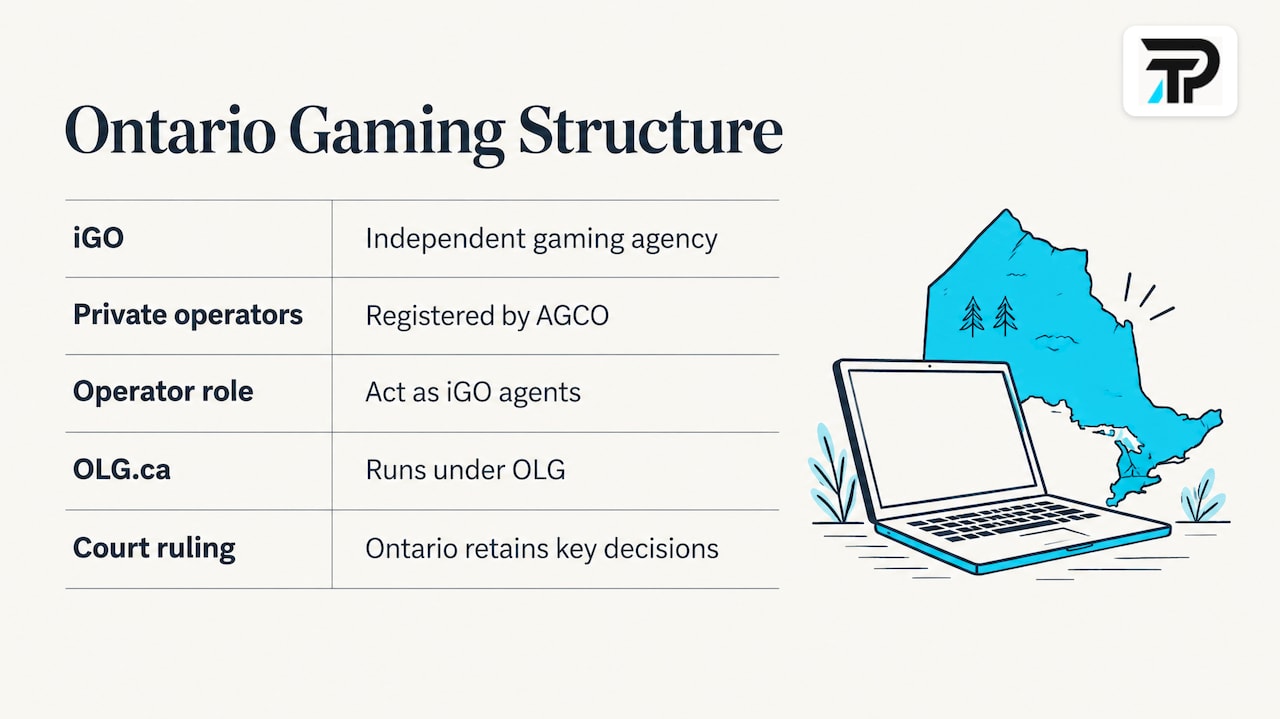
People often use “iGaming Ontario” to mean the whole online casino scene in the province. Strictly, it is one organization within it. iGO is an independent Ontario agency that conducts and manages online gaming offered by regulated private operators. Each operator holds an operating agreement with iGO and acts as its agent when it offers games to you.
The market opened on April 4, 2022, when the AGCO’s Registrar’s Standards for Internet Gaming took effect. According to the AGCO’s overview of internet gaming in Ontario, private operators registered by the AGCO and holding operating agreements with iGO offer games to players, while OLG.ca runs on its own under the Ontario Lottery and Gaming Corporation.
The legal footing was tested recently. In November 2025 the Court of Appeal for Ontario, in Reference re iGaming Ontario, confirmed that operators are private companies acting as agents of iGaming Ontario, offering internet gaming and sports betting through websites and mobile apps. Their operating agreements require them to limit access to players physically located in Ontario. The court explained that the scheme is lawful because Ontario keeps key decision-making power through those agreements. You do not need the legal detail to play, but it explains why the structure looks the way it does.
Who does what: iGO, the AGCO and OLG
The three names appear on logos, news releases and complaint pages, so it helps to keep them apart. We cover the split in more depth in AGCO vs iGaming Ontario: who regulates Ontario casinos.
| Body | Role | What it means for you |
|---|---|---|
| iGaming Ontario (iGO) | Conducts and manages online gaming through operators under operating agreements | Reviews unresolved complaints about iGO-conducted products |
| AGCO | Registers operators, sets and enforces the Registrar’s Standards | Investigates possible rule breaches, can warn, suspend or fine |
| OLG | Conducts and manages OLG.ca separately | A government-run site, outside the private-operator model |
| Private operators | Run the casino and sports betting sites and apps | Your account, deposits, bonuses and first-line complaints |
The AGCO’s standards apply to OLG’s internet gaming site, iGO’s own activities and every registered Ontario internet gaming operator, so the same baseline covers all three.
How to tell whether a site is regulated
This is the check that matters most, because unregulated sites look much like regulated ones. The AGCO warns that unregulated websites may lack dispute resolution, expose your financial information to fraudsters and lack responsible-gambling protections.
iGO’s guidance gives you two steps: look for both the iGaming Ontario and BetGuard logos, then verify the site in iGO’s regulated-site directory. Do both. A logo alone is easy to copy, while the directory is the official list. If you are comparing sites, a full walkthrough is in our guide on how to check if an Ontario casino is legal, and a broader pre-deposit routine is in online casino safety in Ontario.
What to expect from a regulated site when you sign up:
- Age: the market is for people at least 19 and physically located in Ontario. The AGCO’s standards note one narrow exception for someone 18 or older who accesses a site only to buy a lottery ticket.
- Identity checks: iGO’s beginner guide says account creation requires basic personal information and identity verification.
- A digital wallet: the same guide says you need an operator digital wallet to deposit and withdraw.
If an operator asks for none of this, treat that as a reason to stop and check the directory.
Why you have to be in Ontario, and what that means on your phone
The market is built on location. You can open or manage an account elsewhere, but you can only wager while physically in Ontario. Operators enforce this through geolocation on your phone or computer, which is why most mobile apps ask for location permission before they let you play.
In practice:
- Allow location services when the app asks. If you decline, expect the games or betting menus to stay locked.
- Expect a location check each time you log in, and sometimes mid-session.
- Do not use a VPN or other tools that mask where you are. Operators’ terms commonly say that wagers placed outside Ontario can be voided.
- If you travel to another province, you can usually still log in to check your balance or withdraw, but you cannot bet.
We go through the edge cases, such as border towns and weak signal, in Do I have to be in Ontario to gamble online?. Mobile access is also a fair comparison point between sites: how smoothly the location check runs, how the app handles limits and how quickly a withdrawal lands all differ from one operator to the next.
The protections every regulated site must offer
This is where the regulated market gives you more than a bare site would. Under the Registrar’s Standards, as updated in May 2026, every operator must provide the following.
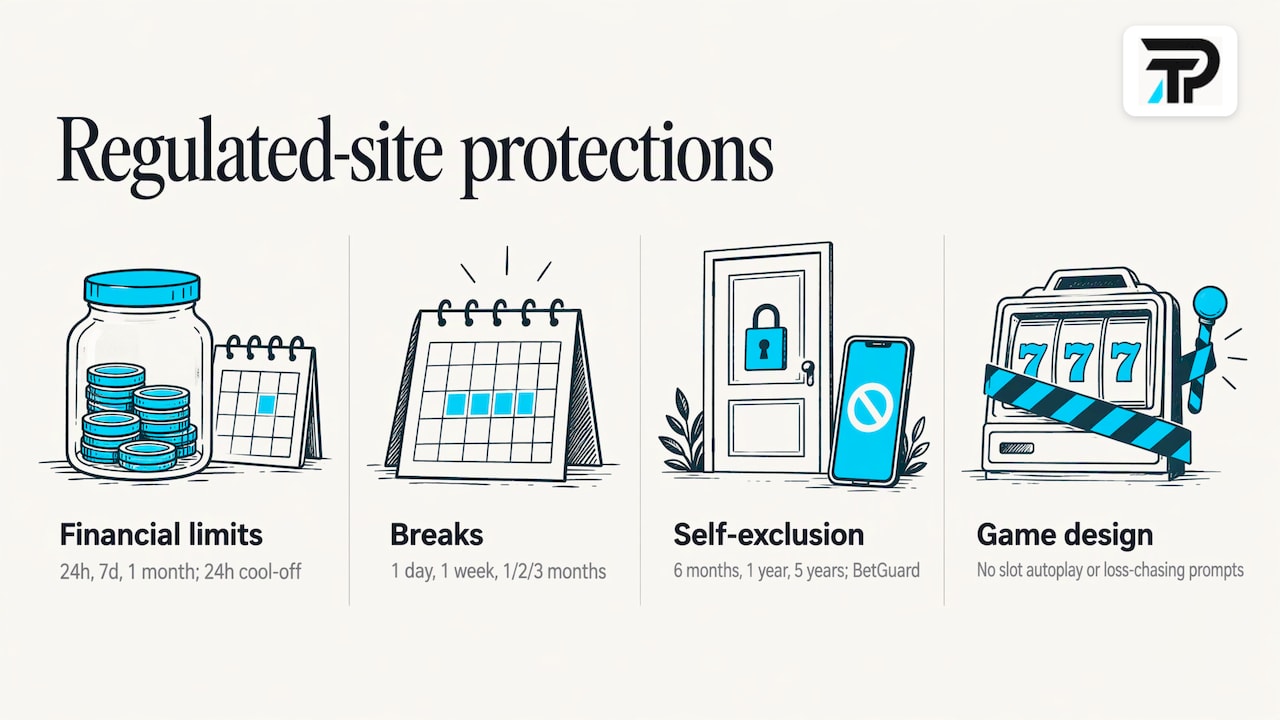
Financial limits. Operators must offer deposit or loss limits with periods that include 24 hours, 7 days and one month. If you ask to relax a limit you already set, a cooling-off period of at least 24 hours applies. That delay is deliberate: it stops a bad hour from undoing a good decision.
Breaks. You can take short-term breaks of one day, one week, one month, two months or three months, during which you cannot place further wagers.
Self-exclusion. Under the AGCO’s standards, self-exclusion terms are six months, one year and five years. Each site has its own tools, and iGO’s FAQ says BetGuard is the option to opt out across regulated Ontario sites. The AGCO’s April 2026 bulletin described the centralized self-exclusion program, with account blocking, marketing suppression and wager refunds, while site-level exclusion remains available.
Game design. The standards require game design that avoids encouraging players to chase losses or keep playing after they have indicated they want to stop, and they prohibit autoplay for slots.
iGO’s own advice is to treat gambling as entertainment rather than income, decide your time and spending limits before you start, and never gamble with money you need for essentials. A practical way to use the tools: set the deposit limit when you open the account, before the first bonus tempts you, and pick the shortest limit period that matches how you actually play. If gambling stops feeling like entertainment, take a break or self-exclude, and consider talking to your doctor or a counsellor.
If something goes wrong: complaints in the regulated market
The route has an order, and skipping a step slows things down.
- Start with the operator. iGO’s player-support page says you should use the operator’s formal complaint process first.
- Escalate to iGO. If the complaint is unresolved or the answer is unsatisfactory, you can submit it to iGO for review for iGO-conducted products. iGO’s service standards say covered complaints are acknowledged within one business day, and they cover disputes where the operator has not responded within 90 days or its response is unsatisfactory.
- Use the AGCO for rule breaches. The AGCO says it does not settle a transaction dispute or recover money, but it investigates possible breaches of the rules and can issue warnings, suspensions or monetary penalties. Complaints about responsible gambling, suspected illegal activity or advertising can go directly to the AGCO when contacting the operator first would be inappropriate.
Keep screenshots of the promotion, your balance and any chat transcripts. A dated record makes a complaint much easier to resolve. This path exists only in the regulated market, which is a strong reason to choose a listed site.
Reading bonus and reward terms
Bonuses are where most players get confused, so Ontario’s rules are worth knowing. The AGCO requires that material conditions and limitations of an offer be disclosed at first presentation, with other terms no more than one click away. An offer cannot be described as free if you must risk or lose your own money, or if conditions attach to that money, and it cannot be called risk-free if you could incur a loss to use or withdraw winnings.
The number to find first is the wagering multiple. iGO’s example: a $10 bonus with a 10x requirement means $100 in wagering before winnings from the bonus are eligible for withdrawal. iGO also advises reading all promotion details before you accept.
A short checklist before you opt in:
- What is the wagering multiple, and does it apply to the bonus alone or to bonus plus deposit?
- Which games count toward it, and by how much?
- Is there a time limit or a maximum withdrawal from bonus winnings?
- Which payment methods are eligible? Deposit methods vary by operator, and iGO suggests checking the operator’s payment policies and asking your financial institution about fees.
Our explainer on what a wagering requirement means in Ontario works through more examples, and casino bonuses in Ontario covers the offer types. For the rules on how operators may advertise these offers, see what online casino ads are allowed in Ontario. If you also like to follow live poker and casino venues beyond online play, a casino and poker room directory lists venues and tournament schedules.
What changed recently
Three developments are worth knowing, since most older guides predate them.
- Centralized self-exclusion. The AGCO’s April 2026 bulletin set out the standard for a program that works across the whole market. iGO’s current FAQ names BetGuard as the cross-site opt-out.
- Training rules. In July 2025 the AGCO removed the requirement for Registrar approval of responsible gambling training programs for casino and lottery employees, while training stays mandatory, regularly updated and based on best practice.
- Court confirmation. The November 2025 Court of Appeal decision confirmed the agent model described above.
Rules like these are updated by the AGCO from time to time, so check the AGCO and iGO pages for the current version of any standard that matters to your decision.
Choosing a site inside the regulated market
Once you know a site is on the official list, the real choice is between operators. Sensible criteria, in order: regulation and registration, the range of safer-gambling tools, clarity of bonus terms, how payments and withdrawals are described, how well the mobile app works, game selection and the quality of customer support. Our safety-first checklist for choosing an online casino turns those into questions you can answer in a few minutes, and Ontario casino game rules and odds explained helps you understand what you are actually playing.
Comparing Ontario casinos with TechPicks
TechPicks is built for adults in Ontario who want a straightforward comparison of online casinos. We rank and review casinos on safety and regulation, game variety, mobile usability, payment and payout clarity, reward terms, customer support and responsible-gambling tools, with operator-specific reviews and details such as the number of games and payout speeds. We earn affiliate commissions when readers follow referral links and complete qualifying actions with an operator.

If you have confirmed how the regulated market works and want to see the options side by side, start with the TechPicks Ontario casino rankings, or browse our Canadian casino research and guides.
FAQ
What is iGaming Ontario in simple terms?
It is the Ontario Crown agency that conducts and manages online gambling offered through private operators. Those operators are registered by the AGCO and hold operating agreements with iGO. OLG.ca is separate and run by OLG.
Is iGaming Ontario the same as the AGCO?
No. The AGCO registers operators, sets the Registrar’s Standards and investigates rule breaches. iGO conducts and manages the gaming and reviews unresolved complaints about the products it conducts. Our guide on AGCO vs iGaming Ontario explains the split.
How old do I have to be, and where do I have to be?
You must be at least 19 and physically in Ontario when you wager. You may be able to manage an account from elsewhere, but you cannot place bets outside the province.
How can I stop playing on every regulated site at once?
BetGuard is the option iGO lists for opting out across regulated Ontario sites. Each site also has its own limits, breaks and self-exclusion tools that meet AGCO standards, so you can combine both.
Sources
- Roles of the AGCO and iGaming Ontario
- Overview of Internet Gaming in Ontario
- Court of Appeal for Ontario, Reference re iGaming Ontario
- Registrar’s Standards for Internet Gaming
- AGCO awareness notice on illegal gambling
- iGaming Ontario: look for the logos
- iGaming Ontario: Regulated iGaming Market
- iGaming Ontario: iGaming 101
- iGaming Ontario: Player FAQs
- AGCO: Responsible Gambling standards
- AGCO: centralized self-exclusion bulletin
- iGaming Ontario: Player Support
- iGaming Ontario: Complaints and Disputes Service Standards
- AGCO: Internet gaming complaints
- AGCO: responsible gambling training standards update
- Casino and poker room directory
Recommended
Explain It To A 12 Year Old
This guide is called “iGaming Ontario Explained: Who Runs the Market and What It Means for You”. Read the guide, follow its source links to check the details, and use what you learn to choose your next step.
Read guide → Check linked sources → Choose your next step